Showing posts with label 2012 day two. Show all posts

Wednesday, September 12, 2012

Virtual Tool Time at #PWWCBA

The final afternoon at PW&WCBA allowed us to fill up our PM & BA toolboxes with some new ideas.

James Franklin, P.E., PMP, Project Manager, Shaw Environmental & Infrastructure gave several examples of PM uses for mind mapping, including building a presentation or PMP study guide.A mind map is a diagram, used to represent word or ideas graphically and can be used for improving brainstorming, collaboration or creating content. By creating these documents using mind mapping software teams can improve collaboration and prevent the rework of having to manually create diagrams or documents.
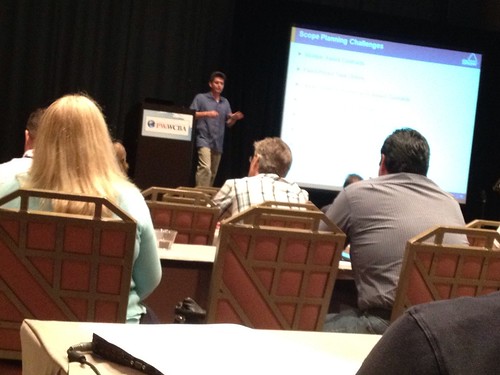
Mind mapping
In "Realizing the Full Potential of the Virtual Team" we learned that a higher level of early organization is correlated to a direct positive impact on the team's productivity, quality & interaction.  In addition to this, in a virtual team you need to be explicit and transparent throughout the project, providing self-service information that is available at all times.

Anyone can be trained to work virtually, but it involves a different skill set than co-located teams (an ability to ask questions and clarify and work independently, amongst others). Communication skills can pose a challenge on any team, but in a virtual team the problem can be exacerbated as modes of communication are removed and communication is often not real-time.

Lindsay Chamberlain suggests several tools for better managing a virtual team:
- Create a team charter that includes information such as expected review/lag times,  scheduling conflicts
- A workload and priorities log to track
- Virtual meeting technologies that prevent confusing conference calls (however, using computer-mediated communication every single time will lower effectiveness, aim for 10% or more person-to-person communication using face-to-face, webcam, or voice-to-voice)
- Regular communication of the vision and goals
- Determine training needs and comfort with virtual environments as soon as possible (first month)
- Open conversations about the virtual environment
- Avoid unintentionally privileging co-located team members

Lastly, Maryann Burns, Senior Project Director, The Travelers Companies, Inc asked "Are your PM Tools Keeping up with the Latest Innovations, Trends and Techniques?" Saying, to know what tool you need, you need to first look at what your purpose is (both today and for the future).  First conduct a current tools assessment and report findings, then design guideposts and develop a road map for implementation.


 Michelle LeBlanc is a Social Media Strategist at IIR USA and the voice behind the @Project_World twitter. She may be reached at mleblanc@iirusa.com 

#PWWCBA Live: Complex Projects

Our second two keynote sessions of the morning were Jim Durkin, SVP, WTC Transportation Hub, Tishman Construction Corporation and Connie Steward, SVP Human Resources & Organizational Development and Lysa Ratliff, Senior Director Cause Marketing and Partner Communications of Habitat for Humanity International.

Jim Durkin spoke on managing complexity and pointed out that complex project teams need to be able to manage: uncertainty, complexity, dynamic interfaces, significant external influences, extra risks that are difficult to quantify, on the spot decision making, prevention of scope creep and more.

In the WTC project (which is actually 8 separate projects) all of these come into play. The organization needs to track literally every piece of steel used from the time it is fabricated and meet various external milestones. The WTC Transportation Hub had to deal with bidding out materials around the world, managing 40 contractors and unions and planning to accommodate over 100,000 passengers per day in the final structure. External influences also created need for various changes, which the project team stays on top of with constant, daily communication: a design change not coming in on time could hold up over 1,000 people working in the field.

Habitat for Humanity Session
Connie Steward and Lysa Ratliff spoke about developing leaders for complex projects. Boundaries of race, culture, gender and more are challenges on Habitat for Humanity projects, build teams may not share a similar language, but these are not the boundaries that are the hardest for leaders in the organization, rather it often comes down to loyalty, respect and trust.

To be a successful leader, focus on processes, relationships & results. Having a common goal, trust and shared accountability will leave you ahead of the game.

Ratliff discussed the shift from managing a project to leading a project and shared the following lessons:
Create the culture first, build an environment of trust.
Get over yourself, it's about others.
Plan for contingencies, but learn to adapt and problem solve.
Focus on details, but don't get lost in them.

Michelle LeBlanc is a Social Media Strategist at IIR USA and the voice behind the @Project_World twitter. She may be reached at mleblanc@iirusa.com 


#PWWCBA Live: "Race Pace" and Collaboration

Don Mann, Former Member, Seal Team Six started off our final morning at PW&WCBA with some insights from his time with Seal Team Six and as a competitive athlete.

Untitled
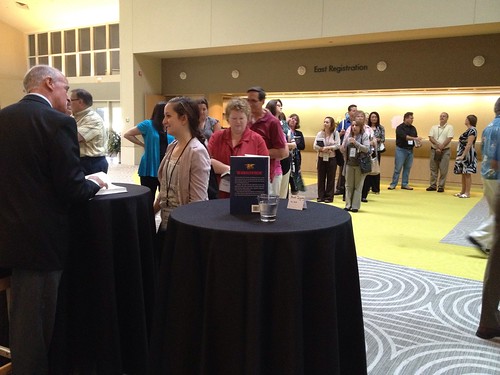
Don Mann signing books at PW&WCBA

Here are some of my key takeaways that can apply to the project management and business analysis world:

- be the quiet professional
- when a new member joins the team, your job is to train him to take over for you when you leave
- be confident and competent, but you won't be an expert in everything. Rely on subject matter experts
- Break macro goals up into micro goals
- Step out of your comfort zone and "train at race pace" (give it all you've got at all times)

Up next, Fredrick Redd, PMP, Director, Project Management Office, Port Authority and New Jersey Transit talked to us about "Developing & Leading an Innovative Approach to Creative, Forward-Looking Collaboration." Port Authority and New Jersey Transitis currently at a crossroads, having been in existence since 1875, there is a need for more collaboration and ultimately innovation. Organizational silos, a culture that is resistant to change and communication issues stand in the way of this. Four primary improvements challenged these silos for better collaboration:

- Public Private Partnerships
   - Reduces delays by increasing efficiency
   - Risks are weighed during all phases for better management
- Integrated Capital Management System
   - Integrate stand alone systems for better transparency of data
   - Standardize process and simplify access to data
- Net Point Scheduling Software
  - Allows intuitive view of project schedule
- BIM 4D Modeling Software
  - Used to model projects such as the World Trade Center Transportation hub, this allows the team to visualize conflicts, design changes and more.

By better communication of vision and strategy and measurement of benefits and lessons learned through these programs, the organization is continuing to break down silos and is more open to new ideas. More than the technical innovations, this transformation has also come from more "soft skills" approaches: using cross-functional teams and a stage gate process PMO.

Michelle LeBlanc is a Social Media Strategist at IIR USA and the voice behind the @Project_World twitter. She may be reached at mleblanc@iirusa.com