Showing posts with label First Main Conference Day 2012. Show all posts

Tuesday, September 11, 2012

#PWWCBA live: The biggest challenge to decision making? Risk.

Untitled
Michael Thorn started his afternoon session at ProjectWorld discussing whole body decisions, which is to say, the following three inputs on which we base decisions:

Brain = Rational logic
Heart = Passion
Gut = Intuition (Lack of data and/or time)

Passionate, "heart" decisions may make us feel the best, but "brain" based decisions are the easiest to back up. Data analysis, mainly performed by lower level employees, is what is going to drive many professional decisions, but ultimately it may be upper level management who reviews the results and determines success.

Here are my key takeaways:

Decision making is what all workers do, and what steers what the organization does.
Most organizations are good at doing analysis and investigation, but struggle with the "pivot point" of actually making a decision.


Ultimate criterion: does the decision create a positive outcome for the person and/or organization?

For effective decision making: consider alternate approaches and scenarios, assign (or accept) accountability for decisions, and communicate, communicate, communicate.

You can follow the 40-80 rule when timing is important: you need at least 40% off the data, but don't need to wait for all data to be available, make a decision with 80% of the data.

The biggest challenge to decision making? Risk. 
Risk management can help with this:
Identify what could go wrong, assign a probability of occurrence, and then determine the qualitative or quantitative impact. Mitigation  of these impacts is where you start making decisions. Knowing you have an ability to compensate for these risks (such as a project management contingency fund) may lead to more willingness to take risks.
Risk management is not a tool, it is a process of identification, analysis, control & measurement of outcomes that has to be carried out throughout the project to the very end.
Focus on the drivers & critical factors
Nothing replaces project knowledge and nothing replaces your judgement

Michelle LeBlanc is a Social Media Strategist at IIR USA and the voice behind the @Project_World twitter. She may be reached at mleblanc@iirusa.com


#PWWCBA Live: Tools, Techniques & Trends


Six Sigma in Software Development
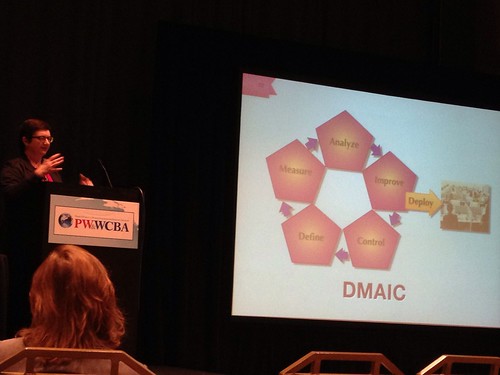
I started the first afternoon of track sessions at ProjectWorld in "Six Sigma and the Software Development Life Cycle – a Match Made in Heaven, Maybe." Speaker Rebecca Burgess started off by defining the SDLC and then pointing out it's weaknesses (often tactical, short-term, poor requirements definition and may end with deployment) and then showing ways that Six Sigma can help fill this shortcomings.

Six Sigma for the Software Development Life Cycle is looking to accomplish "Strategic Success" - actual long term, implemented change. To do this, one should begin by documenting the default success criteria, gathering requirements from various sources (the voice of the customer, voice of the data, voice of the business & IT and looking at best practices from outside the company), performing comparative analysis and controlling business processes (using SIPOC & Swimlanes for example).

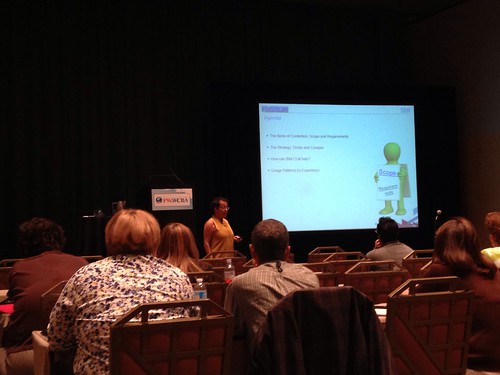
Up next was "Divide and Conquer: Bridging the Gap Between Scope and Requirements Managements with CLM Tools" with Cherifa Mansoura, PhD, Solution Architect, IBM
Bridging the gap between scope & requirements

Mansoura started the session by asking, are scope and requirements the same? Scope is the work that needs to be accomplished on the project (the product scope is the set of features that need to be developed on a product). Requirements are either derived from user needs or stated in a document such as a contract or standard specifications. The scope elements are NOT ONLY the requirements.

Every project must establish it's scope: what's in, what's out. Think of your scope as a box that contains both your requirements and other elements (change requests, risk, etc.) The container manages all of the work items inside the box.

Still to come this afternoon is our book signing with Ellen Gottesdiener and another track after the break.

Michelle LeBlanc is a Social Media Strategist at IIR USA and the voice behind the @Project_World twitter. She may be reached at mleblanc@iirusa.com


Live at #PWWCBA: Manipulate Your Way To Collaborative Culture

Harvey A Robbins
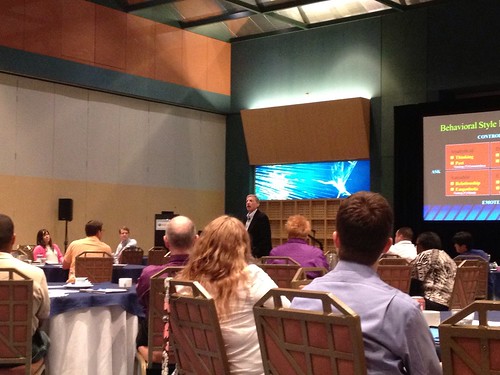
Harvey A. Robbins started us off at the first main conference day with three ways to develop a collaborative culture:
1. Select members of your team who have a natural tendency towards sharing information without the expectation of reciprocity
2. Teamwork and establishing clear expectations: Setting up goals, dividing up roles & holding people accountable
3. Manipulation: Use knowledge of personalities to build a team that works together
  • "Drivers" - outcome driven, process oriented, feedback rich. Good to delegate to and task oriented. Want to hear the 'what?"
  • "Expressives" - Creative, good for new product development. Want to hear the "why?"
  • "Analyticals" - Will keep you from making mistakes by tracking information and details. Want to know the "How?"
  • "Amiables" - People and friendship related, collaboration and communication focused. Want to know the "who?"
The question that Robbins recommends all managers keep in mind is "Who is responsible for what, by when, and how will we check with each other that we're on track?" When you are communicating with all personalities ("Broadcast versatility") you can speak to all potential readers by answer all questions and providing information on past events, future focus, details and the people that will be effected.

Michelle LeBlanc is a Social Media Strategist at IIR USA and the voice behind the @Project_World twitter. She may be reached at mleblanc@iirusa.com